
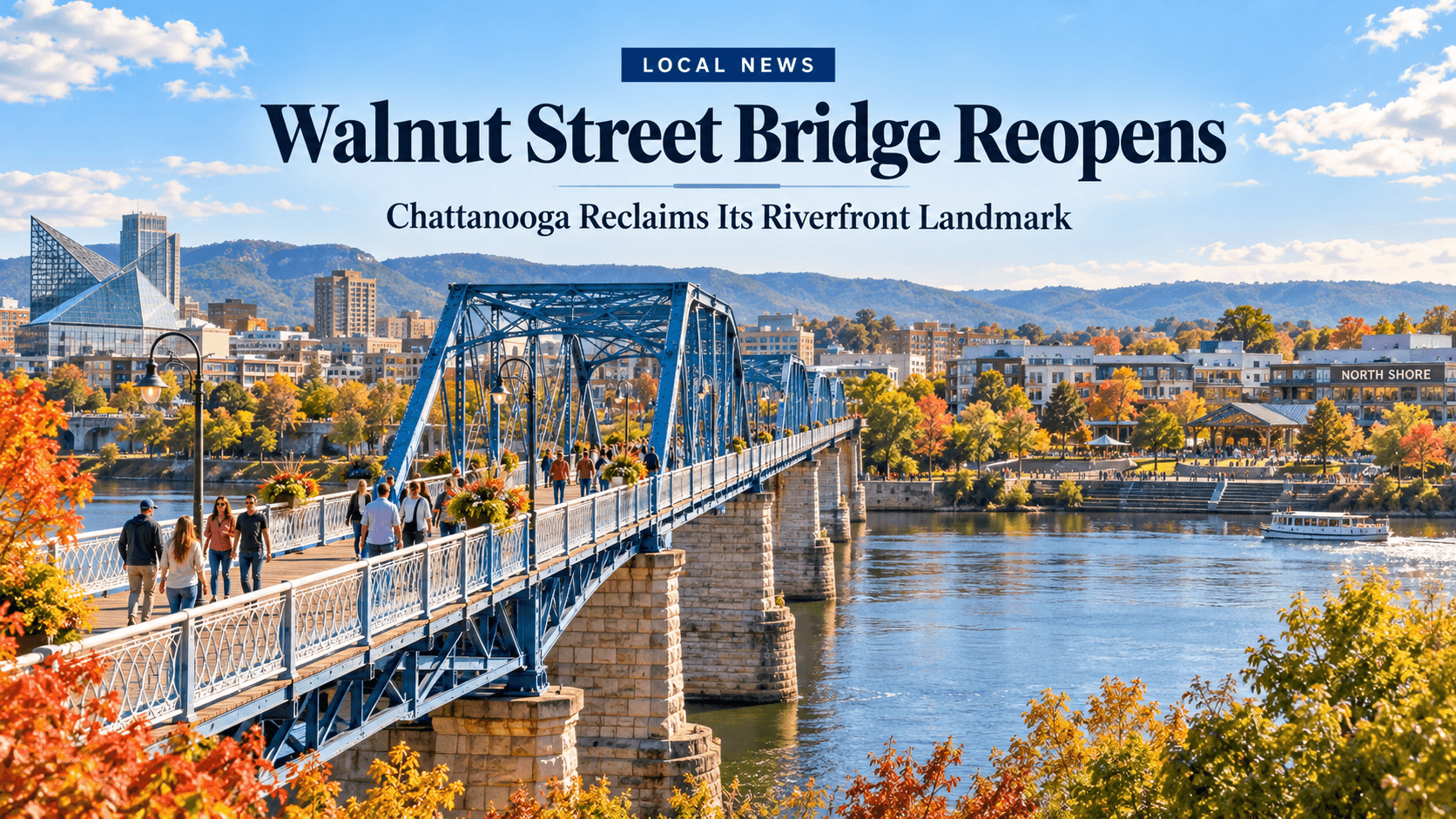
Walnut Street Bridge Reopens: Chattanooga Reclaims Its Riverfront Landmark |
The historic pedestrian crossing is welcoming walkers again after an extensive renovation |
A Familiar Walk Returns
For more than a year, one of Chattanooga's best-loved walks across the Tennessee River was missing from everyday life.
On October 3, 2026, the Walnut Street Bridge reopened to the public following a major restoration that had closed the pedestrian landmark since March 2025.
Families, downtown visitors, and North Shore residents once again have a direct way to cross between two of Chattanooga's most recognizable districts on foot.
The reopening was celebrated with a noon public program, a ceremonial walk across the bridge, and family activities near its entrances.
The historic crossing has long served as far more than a convenient route.
It connects communities, anchors the riverfront experience, and gives Chattanooga one of its signature views.
What Changed During the Restoration
The project addressed serious wear in the structure's steel, wood decking, lighting, and pedestrian amenities.
Engineers replaced or refurbished major steel elements, including supports extending from the suspension system toward the bridge piers.
City officials reported that the work involved more than 200,000 pounds of steel.
The project also included new decking, painting, lighting, accessibility improvements, and renewed amenities such as benches and landscaping.
Replacing deteriorated materials was necessary to help preserve the bridge for the next generation.
The improvements are not simply cosmetic, even though visitors immediately notice the renewed blue structure and fresh walking surface.
Earlier city updates placed the work at approximately $47 million, while reporting around the reopening described a larger final restoration figure.
Regardless of which budget snapshot is used, the restoration represents a substantial investment in a prominent public landmark.
Why the Bridge Matters to Downtown
The Walnut Street Bridge links the downtown riverfront near the Hunter Museum and Bluff View area with the North Shore's parks, shops, and neighborhood streets.
A person can walk across for lunch, meet friends, visit an attraction, or simply enjoy the river from above.
That pedestrian connection helps restaurants, businesses, and recreational destinations on both sides feel like parts of the same urban experience.
During the closure, visitors relied on alternate routes, including the Market Street and Veterans bridges.
Restoring the familiar crossing brings back a route that many people associate with exploring Chattanooga without getting into a car.
The bridge's value is also symbolic.
Built in 1890, it survived changing transportation needs and was eventually transformed into a pedestrian destination through community preservation efforts.
A History Worth Remembering Fully
The bridge carries difficult history alongside its more celebratory role in downtown revitalization.
In 1906, Ed Johnson, a Black man whose case reached the United States Supreme Court, was lynched at the bridge by a racist mob.
That history deserves direct acknowledgment whenever the landmark's significance is discussed.
A restored crossing can be a point of pride while also encouraging residents to remember the people and events that shaped its past.
Its history spans transportation, racial injustice, grassroots preservation, and a changing relationship between the city and its river.
A New Chapter for a Familiar Place
The restored bridge gives residents and visitors a renewed reason to spend time along the waterfront.
Walkers can once again pause above the river, observe the city from a different angle, and continue into another neighborhood without leaving the pedestrian network.
For local businesses, the connection may help restore foot traffic patterns interrupted by construction.
For families, it brings back a familiar, low-cost outing in the center of the city.
The reopening does not erase the bridge's complicated history, but it ensures the structure remains part of Chattanooga's future.
Sometimes progress means building something new.
In this case, it also means taking care of something generations of residents have already come to value. |
0 Comments
Join the conversation
Be the first to comment
Share your thoughts above.